

ინგლისური

Suicide: A Study in Sociology – Emile Durkheim
68,00 ₾There would be no need for sociology if everyone understood the social frameworks within which we operate. That we do have a connection to the larger picture is largely thanks to the pioneering thinker Émile Durkheim. He recognized that, if anything can explain how we as individuals relate to society, then it is suicide: Why does it happen? What goes wrong? Why is it more common in some places than others? In seeking answers to these questions, Durkheim wrote a work that has fascinated, challenged and informed its readers for over a hundred years. Far-sighted and trail-blazing in its conclusions, Suicide makes an immense contribution to our understanding to what must surely be one of the least understandable of acts. A brilliant study, it is regarded as one of the most important books Durkheim ever wrote.

Economic Philosophy – Joan Robinson
75,00 ₾In Economic Philosophy Robinson looks behind the curtain of economics to reveal a constant battle between economics as a science and economics as ideology, which she argued was integral to economics. In her customary vivid and pellucid style, she criticizes early economists Adam Smith and David Ricardo, and neo-classical economists Alfred Marshall, Stanley Jevons and Leon Walras, over the question of value. She shows that what they respectively considered to be the generators of value – labour-time, marginal utility or preferences – are not scientific but ‘metaphysical’, and that it is frequently in ideology, not science, that we find the reason for the rejection of economic theories. She also weighs up the implications of the Keynesian revolution in economics, particularly whether Keynes’s theories are applicable to developing economies. Robinson concludes with a prophetic lesson that resonates in today’s turbulent and unequal economy: that the task of the economist is to combat the idea that the only values that count are those that can be measured in terms of money.





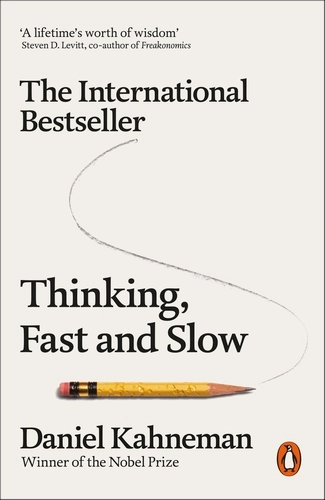
Thinking, Fast and Slow
75,00 ₾Why is there more chance we’ll believe something if it’s in a bold type face? Why are judges more likely to deny parole before lunch? Why do we assume a good-looking person will be more competent? The answer lies in the two ways we make choices: fast, intuitive thinking, and slow, rational thinking. This book reveals how our minds are tripped up by error and prejudice (even when we think we are being logical), and gives you practical techniques for slower, smarter thinking, enabling you to make better decisions at work, at home, and in everything you do.




Live with Color
40,00 ₾This book is for anyone who loves art, beginners, hobbyists, or curious creators.


