

Routledge






The Protestant Ethic and the Spirit of Capitalism
57,00 ₾Max Weber’s best-known and most controversial work, The Protestant Ethic and the Spirit of Capitalism, first published in 1904, remains to this day a powerful and fascinating read. Weber’s highly accessible style is just one of many reasons for his continuing popularity. The book contends that the Protestant ethic made possible and encouraged the development of capitalism in the West. Widely considered as the most informed work ever written on the social effects of advanced capitalism, The Protestant Ethic and the Spirit of Capitalism holds its own as one of the most significant books of the twentieth century. The book is one of those rare works of scholarship which no informed citizen can afford to ignore.
Sports Coaching: The Basics
Original price was: 72,00 ₾.58,00 ₾Current price is: 58,00 ₾.Sports Coaching: The Basics is an engaging and provocative introduction to sports coaching which combines coaches’ views and experiences of their work with discussions and topical issues that feature in this fast-growing field. In doing so. coaches are placed at the centre of the discussions relating to philosophical. historical. sociological. psychological and pedagogical interpretations of contemporary practice. Consequently. the book prompts questions such as:
What is coaching?
What does it mean to be a coach?
How do coaches influence athletes/players?
How do coaches learn?
What is it like to be a coach?
In considering these questions. readers are encouraged to reflect upon their experiences of coaching and to start conversations with others about coaches’ work. Therefore. the book is of use for coaches. those interested in studying sports coaching. and coach educators or facilitators of coach learning initiatives.

Sport Management: The Basics
Original price was: 72,00 ₾.58,00 ₾Current price is: 58,00 ₾.Sport Management: The Basics is an engaging and accessible introduction to sport management which considers a range of contemporary philosophical. social. cultural and political matters as they impact on this growing field. Drawing links between academic theory and practice. it explores the current challenges facing managers in the sport industry. addressing topics including:
the history of sport management
the role of the manager
levels of management
the public. private and voluntary sectors
sport management in the global marketplace
With suggestions for further reading throughout the text. a comprehensive chapter on employment and employability. and case studies which explore both theory and practice. Sport Management: The Basics offers a clear and concise introduction for anyone seeking to study or work in sport management.

Psychology from An Empirical Standpoint
73,00 ₾Franz Brentano is one of the founding fathers of twentieth century philosophy, celebrated for introducing the concept of intentionality to philosophy as well as making significant contributions to ethics and logic. His work exerted great influence on major philosophers such as Edmund Husserl, but also philosophers travelling in the opposite direction, such Gottlob Frege. He counted Sigmund Freud amongst his students and Freud expressed great admiration for his teacher in several letters.
Psychology from an Empirical Standpoint is Brentano’s most important and brilliant work. It helped to establish psychology as a scientific discipline, but did so in a highly original and distinctive manner by arguing for a form of introspectionism. Brentano argued that consciousness is always unified and that the hallmark of the mind is that one’s thoughts are always directed towards something – his famous theory of ‘intentionality’ – arguments that have deep implications not just for philosophy but psychology, cognitive science and consciousness studies.
With a new foreword by Tim Crane.


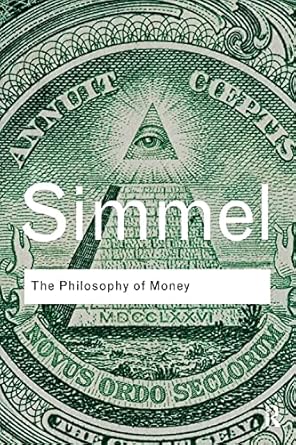
The Philosophy of Money
82,00 ₾With a new foreword by Charles Lemert
‘Its greatness…lies in ceaseless and varied use of the money form to unearth and conceptually reveal incommensurabilities of all kinds, in social reality fully as much as in thought itself.’ – Fredric Jameson
In The Philosophy of Money, Georg Simmel puts money on the couch. He provides us with a classic analysis of the social, psychological and philosophical aspects of the money economy, full of brilliant insights into the forms that social relationships take. He analyzes the relationships of money to exchange, human personality, the position of women, and individual freedom. Simmel also offers us prophetic insights into the consequences of the modern money economy and the division of labour, in particular the processes of alienation and reification in work and urban life.
An immense and profound piece of work it demands to be read today and for years to come as a stunning account of the meaning, use and culture of money.
Georg Simmel (1858-1918) was born in Berlin, the youngest of seven children. He studied philosophy and history at the University of Berlin and was one of the first generation of great German sociologists that included Max Weber.
The Order of Things
68,00 ₾When one defines “order” as a sorting of priorities, it becomes beautifully clear as to what Foucault is doing here. With virtuoso showmanship, he weaves an intensely complex history of thought. He dips into literature, art, economics and even biology in The Order of Things, possibly one of the most significant, yet most overlooked, works of the twentieth century. Eclipsed by his later work on power and discourse, nonetheless it was The Order of Things that established Foucault’s reputation as an intellectual giant. Pirouetting around the outer edge of language, Foucault unsettles the surface of literary writing. In describing the limitations of our usual taxonomies, he opens the door onto a whole new system of thought, one ripe with what he calls “exotic charm”. Intellectual pyrotechnics from the master of critical thinking, this book is crucial reading for those who wish to gain insight into that odd beast called Postmodernism, and a must for any fan of Foucault.

The Birth of the Clinic
68,00 ₾In this remarkable book Michel Foucault, one of the most influential thinkers of recent times, calls us to look critically at specific historical events in order to uncover new layers of significance. In doing so, he challenges our assumptions not only about history, but also about the nature of language and reason, even of truth. The scope of such an undertaking is vast, but by means of his uniquely engaging narrative style, Foucault’s penetrating gaze is skilfully able to confront our own. After reading his words our perceptions are never quite the same again.
Madness and Civilization
68,00 ₾In this classic account of madness, Michel Foucault shows once and for all why he is one of the most distinguished European philosophers since the end of World War II. Madness and Civilization,Foucault’s first book and his finest accomplishment, will change the way in which you think about society. Evoking shock, pity and fascination, it might also make you question the way you think about yourself.
Archaeology of Knowledge
68,00 ₾In France, a country that awards its intellectuals the status other countries give their rock stars, Michel Foucault was part of a glittering generation of thinkers, one which also included Sartre, de Beauvoir and Deleuze. One of the great intellectual heroes of the twentieth century, Foucault was a man whose passion and reason were at the service of nearly every progressive cause of his time. From law and order, to mental health, to power and knowledge, he spearheaded public awareness of the dynamics that hold us all in thrall to a few powerful ideologies and interests. Arguably his finest work, Archaeology of Knowledge is a challenging but fantastically rewarding introduction to his ideas.
The Jargon of Authenticity
65,00 ₾Theodor Adorno was no stranger to controversy. In The Jargon of Authenticity he gives full expression to his hostility to the language employed by certain existentialist thinkers such as Martin Heidegger. With his customary alertness to the uses and abuses of language, he calls into question the jargon, or ‘aura’, as his colleague Walter Benjamin described it, which clouded existentialists’ thought. He argued that its use undermined the very message for meaning and liberation that it sought to make authentic. Moreover, such language – claiming to address the issue of freedom – signally failed to reveal the lack of freedom inherent in the capitalist context in which it was written. Instead, along with the jargon of the advertising jingle, it attributed value to the satisfaction of immediate desire. Alerting his readers to the connection between ideology and language, Adorno’s frank and open challenge to directness, and the avoidance of language that ‘gives itself over either to the market, to balderdash, or to the predominating vulgarity’, is as timely today as it ever has been.

Waiting for God
60,00 ₾You cannot get far in these essays without sensing yourself in the presence of a writer of immense intellectual power and fierce independence of mind.’ – Janet Soskice, from the Introduction to the Routledge Classics edition
Simone Weil (1909–1943) is one of the most brilliant and unorthodox religious and philosophical thinkers of the twentieth century. She was also a political activist who worked in the Renault car factory in France in the 1930s and fought briefly as an anarchist in the Spanish Civil War. Hailed by Albert Camus as ‘the only great spirit of our times,’ her work spans an astonishing variety of subjects, from ancient Greek philosophy and Christianity to oppression, political freedom and French national identity.
Waiting for God is one of her most remarkable books, full of piercing spiritual and moral insight. The first part comprises letters she wrote in 1942 to Jean-Marie Perrin, a Dominican priest, and demonstrate the intense inner conflict Weil experienced as she wrestled with the demands of Christian belief and commitment. She then explores the ‘just balance’ of the world, arguing that we should regard God as providing two forms of guidance: our ability as human beings to think for ourselves; and our need for both physical and emotional ‘matter.’ She also argues for the concept of a ‘sacred longing’; that humanity’s search for beauty, both in the world and within each other, is driven by our underlying desire for a tangible god.
Eloquent and inspiring, Waiting for God asks profound questions about the nature of faith, doubt and morality that continue to resonate today.
This Routledge Classics edition includes a new Introduction by Janet Soskice and retains the Foreword to the 1979 edition by Malcolm Muggeridge.

Man Meets Dog
48,00 ₾In this wonderful book, the famous scientist and best-selling author, Konrad Lorenz, ‘the man who talked with animals’, enlightens and entertains us with his illustrated account of the unique relationship between humans and their pets. Displaying Lorenz’s customary humanity and expert knowledge of animals, Man Meets Dog is also a deeply personal and entertaining account of his relationships with his own four-legged friends. With charming sketches on almost every page, Man Meets Dog offers a delightful insight into animal and human thinking and feeling. An essential companion for all lovers of dogs (and cats!).

The Spirit in Man, Art and Literature
65,00 ₾The Spirit in Man, Art and Literature offers unique and penetrating insights into the lives and opinions of some of the most significant players in the cultural life of the twentieth century. Carl Gustav Jung was at the heart of that cultural life, pioneering, along with Freud, a new interpretation of what it meant to be human in the modern age. This volume reveals the full range of Jung’s involvement in this process, from his famous analysis of ‘Psychology and Literature’ to his landmark texts on Joyce’s Ulysses and Picasso’s paintings. Jung writes of Freud from the perspective of one who was “permitted a deep glimpse into the mind of this remarkable man,” and through the memories and opinions recorded in The Spirit in Man, Art and Literature, the reader is offered a similar privilege.

The Science of Mythology
65,00 ₾When Carl Jung and Carl Kerenyi got together to collaborate on this book, their aim was to elevate the study of mythology to a science. Kerenyi wrote on two of the most ubiquitous myths, the Divine Child and The Maiden, supporting the core ‘stories’ with both an introduction and a conclusion. Jung then provided a psychological analysis of both myths. He defined myth as a story about heroes interacting with the gods. Having long studied dreams and the subconscious, Jung identified certain dream patterns common to everyone. These ‘archetypes’ have developed through the centuries, and enable modern people to react to situations in much the same way as our ancestors. From nuclear annihilation to AIDS and Ebola, we continue to engage the gods in battle. Science of Mythology provides an account of the meaning and the purpose of mythic themes that is linked to modern life: the heroic battles between good and evil of yore are still played out, reflected in contemporary fears.

Psychology and the East
65,00 ₾These writings of his are strongly alive; in most instances Jung does not present us with final solutions and last words about any of the great East-West problems, but rather with suggestions for a deeper kind of approach, thus opening up new planes of investigation.’ – Journal of Analytical Psychology
“My own world of European consciousness had become peculiarly thin… it is quite possible that India is the real world and that the white man lives in a madhouse of abstractions.” C.G. Jung was inspired to write these words after his very first visit to India. Long concerned with the hold that myth and archetype had on the human psyche, it was inevitable that the legendary psychoanalyst would turn his attention to Eastern modes of thought. Psychology and the East collects together many of Jung’s most memorable writings on the subject, including his Psychological commentaries on the I Ching and The Tibetan Book of the Dead, his thoughts on Buddhism and Islam and a full travelogue of that fateful first encounter with India in 1936.
On the Nature of the Psyche
75,00 ₾Jung’s discovery of the ‘collective unconscious’, a psychic inheritance common to all humankind, transformed the understanding of the self and the way we interpret the world. In On the Nature of the Psyche Jung describes this remarkable theory in his own words, and presents a masterly overview of his theories of the unconscious, and its relation to the conscious mind. Also contained in this collection is On Psychic Energy, where Jung defends his interpretation of the libido, a key factor in the breakdown of his relations with Freud. For anyone seeking to understand Jung’s insights into the human mind, this volume is essential reading.
Totem and Taboo
76,00 ₾Widely acknowledged to be one of Freud’s greatest cultural works, when Totem and Taboo was first published in 1913, it caused outrage. Thorough and thought-provoking, Totem and Taboo remains the fullest exploration of Freud’s most famous themes. Family, society, religion – they’re all put on the couch here. Whatever your feelings about psychoanalysis, Freud’s theories have influenced every facet of modern life, from film and literature to medicine and art. If you don’t know your incest taboo from your Oedipal complex, and you want to understand more about the culture we’re living in, then Totem and Taboo is the book to read.

Humanism and Terror
68,00 ₾First published in France in 1947, Humanism and Terror is a vital work of political philosophy by one of the leading French philosophers of the twentieth century. Attempting to understand what he called the “dislocated world” that followed immediately after the Second World War—including his own, divided France—Merleau-Ponty asks a fundamental question: how did Marxism and humanism come apart?
Through a fascinating reading of Arthur Koestler’s famous novel, Darkness at Noon, an allegory of the Stalinist show trials and purges of the 1930s, Merleau-Ponty weighs up the costs of a regime of permanent revolution and false confessions. His profound and controversial point, however, is that the purges were the inevitable outcome of abandoning crucial subjective elements of Marx’s theory of history, with the result that “humanism is suspended and government is terror.”
As we again confront the reality of authoritarianism, political polarisation and curtailing of human freedom, the dislocated world brilliantly depicted by Merleau-Ponty in Humanism and Terror sends a powerful and articulate message that continues to resonate today.
This Routledge Classics edition includes a new Foreword by William McBride.

Keeping Faith
65,00 ₾The sheer range of West’s interests and insights is staggering and exemplary: he appears equally comfortable talking about literature, ethics, art, jurisprudence, religion, and popular-cultural forms.’ – Artforum
Keeping Faith is a rich, moving and deeply personal collection of essays from one of the leading African American intellectuals of our age. Drawing upon the traditions of Western philosophy and modernity, Cornel West critiques structures of power and oppression as they operate within American society and provides a way of thinking about human dignity and difference afresh. Impressive in its scope, West confidently and deftly explores the politics and philosophy of America, the role of the black intellectual, legal theory and the future of liberal thought, and the fate of African Americans. A celebration of the extraordinary lives of

The Philosophy of ‘As If’
80,00 ₾Hans Vaihinger (1852–1933) was an important and fascinating figure in German philosophy in the early twentieth century, founding the well-known journal Kant-Studien. Yet he was overshadowed by the burgeoning movements of phenomenology and analytical philosophy, as well as hostility towards his work because of his defense of Jewish scholars in a Germany controlled by Nazism.
However, it is widely acknowledged today that The Philosophy of ‘As If’ is a philosophical masterwork. Vaihinger argues that in the face of an overwhelmingly complex world, we produce a simpler set of ideas, or idealizations, that help us negotiate it. When cast as fictions, such ideas provide an easier and more useful way to think about certain subjects, from mathematics and physics to law and morality, than would the truth in all its complexity. Even in science, he wrote, we must proceed “as if ” a material world exists independently of perceiving subjects; in behaviour, we must act “as if ” ethical certainty were possible; in religion, we must believe “as if” there were a God. He also explores the role of fictions in the history of philosophy, going back to the ancient Greeks and the work of Leibniz, Adam Smith and Bentham.
The Philosophy of ‘As If’ was a powerful influence on the emerging philosophical movement of pragmatism and was groundbreaking in its anticipation of the central role that model-building and simulation would come to play in the human sciences.
This Routledge Classics edition includes a new foreword by Michael A. Rosenthal, which provides a fascinating and important background to Vaihinger’s life and the legacy of The Philosophy of ‘As If’.
The Explanation of Behaviour
74,00 ₾The Explanation of Behaviour was the first book written by the renowned philosopher Charles Taylor. A vitally important work of philosophical anthropology, it is a devastating criticism of the theory of behaviourism, a powerful explanatory approach in psychology and philosophy when Taylor’s book was first published. However, Taylor has far more to offer than a simple critique of behaviourism. He argues that in order to properly understand human beings, we must grasp that they are embodied, minded creatures with purposes, plans and goals, something entirely lacking in reductionist, scientific explanations of human behaviour.
Taylor’s book is also prescient in according a central place to non-human animals, which like human beings are subject to needs, desires and emotions. However, because human beings have the unique ability to interpret and reflect on their own actions and purposes and declare them to others, Taylor argues that human experience differs to that of other animals. Furthermore, the fact that human beings are often directed by their purposes has a fundamental bearing on how we understand the social and moral world.
Taylor’s classic work is essential reading for those in philosophy and psychology as well as related areas such as sociology and religion.
This Routledge Classics edition includes a new Preface by the author and a new Foreword by Alva Noë, setting the book in philosophical and historical context.