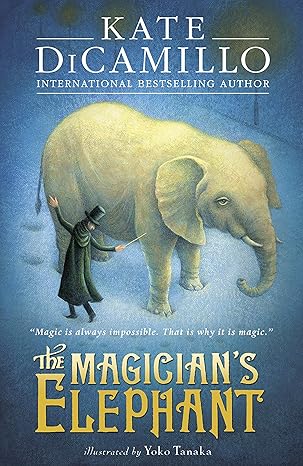
Magician’s Elephant

24,00 

When a fortuneteller’s tent appears in the market square of the city of Baltese, orphan Peter Augustus Duchene knows the questions that he needs to ask: Does his sister still live? And if so, how can he find her? The fortuneteller’s mysterious answer (an elephant! An elephant will lead him there!) sets off a chain of events so remarkable, so impossible, that you will hardly dare to believe it’s true. With atmospheric illustrations by fine artist Yoko Tanaka, here is a dreamlike and captivating tale that could only be narrated by Newbery Medalist Kate DiCamillo. In this timeless fable, she evokes the largest of themes — hope and belonging, desire and compassion — with the lightness of a magician’s touch.
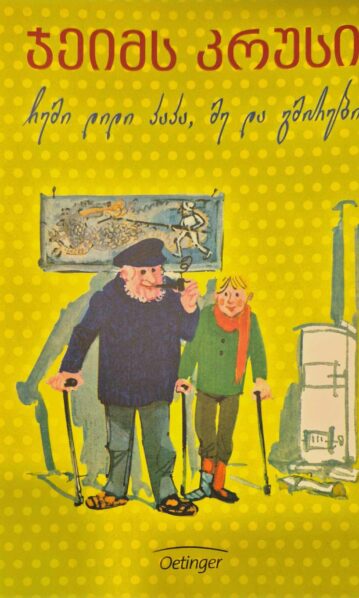
ჩემი დიდი პაპა, მე და გმირები

10,00 

ჯეიმს კრუსი არის ერთ-ერთი ყველაზე ცნობილი გერმანელი საბავშვო ავტორი. მიღებული აქვს გერმანული ახალგაზრდული ლიტერატურის და “ჰანს კრისტიან ანდერსენის” პრემიები
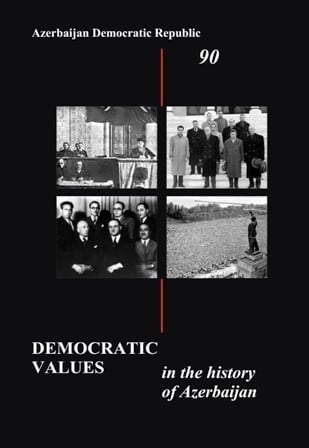
Democratic values in the history of azerbaijan

16,80 

Edited by Leila Alieva, Democratic values in the history of Azerbaijan is the latest publication of the Center for National and International Studies.

It details the proceedings of eight round tables which the Centre for National and International Studies completed in 2008-2009 in the regions of Azerbaijan.These conferences were conducted in Sheki, Ganja, Salyan, Shirvan, Guba, Masalli, Balakan and Barda in connection with the 90th anniversary of the first democratic republic of Azerbaijan – the Azerbaijan Democratic Republic – of 1918-1920.

Tales of Ordinary Madness

28,00 

In these tales of ordinary madness, Charles Bukowski ingeniously mixes high and low culture, from prostitutes and the philosophy of Kant to despair and classical music, to create his modern dystopia. Inspired by DH Lawrence, John Fante and Hemingway, Bukowski’s writing is passionate, extreme and relentlessly realistic. These are angry yet tender, humorous and haunting portrayals of life in the underbelly of America.

Island

29,00 

For over a hundred years the Pacific island of Pala has been the scene of a unique experiment in civilisation. Its inhabitants live in a society where western science has been brought together with eastern philosophy and humanism to create a paradise on earth. When cynical journalist, Will Farnaby, arrives to search for information about potential oil reserves on Pala, he quickly falls in love with the way of life on the island. Soon the need to complete his mission becomes an intolerable burden. In counterpoint to Brave New World and Ape and Essence, in Island Huxley gives us his vision of utopia.

Principles of Mathematics

74,00 

First published in 1903, Principles of Mathematics was Bertrand Russell’s first major work in print. It was this title which saw him begin his ascent towards eminence. In this groundbreaking and important work, Bertrand Russell argues that mathematics and logic are, in fact, identical and what is commonly called mathematics is simply later deductions from logical premises. Highly influential and engaging, this important work led to Russell’s dominance of analytical logic on western philosophy in the twentieth century.

Our Knowledge of the External World

74,00 

Our Knowledge of the External World isa compilation of lectures Bertrand Russell delivered in the US in which he questions the very relevance and legitimacy of philosophy. In it he investigates the relationship between ‘individual’ and ‘scientific’ knowledge and questions the means in which we have come to understand our physical world. This is an explosive and controversial work that illustrates instances where the claims of philosophers have been excessive, and examines why their achievements have not been greater.

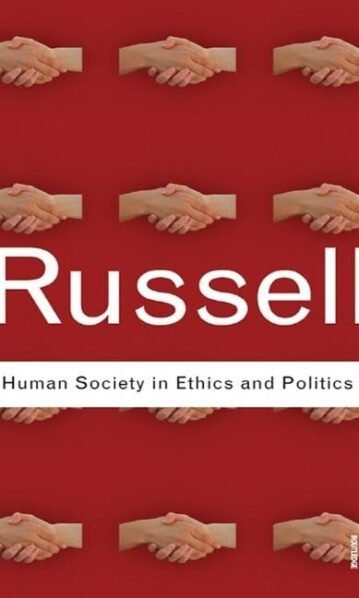
Human Society in Ethics and Politics

60,00 

First published in 1954, Human Society in Ethics and Politics is Bertrand Russell’s last full account of his ethical and political positions relating to both politics and religion. Ethics, he argues, are necessary to man because of the conflict between intelligence and impulse – if one were without the other, there would be no place for ethics. Man’s impulses and desires are equally social and solitary. Politics and ethics are the means by which we as a society and as individuals become socially purposeful and moral codes inculcate our rules of action.
Human Knowledge: Its Scope and Limits

56,00 

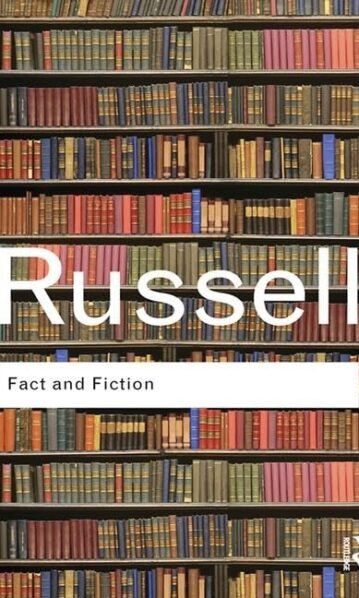
How do we know what we “know”? How did we –as individuals and as a society – come to accept certain knowledge as fact? In Human Knowledge, Bertrand Russell questions the reliability of our assumptions on knowledge. This brilliant and controversial work investigates the relationship between ‘individual’ and ‘scientific’ knowledge. First published in 1948, this provocative work contributed significantly to an explosive intellectual discourse that continues to this day.

Fact and Fiction

68,00 

First published in 1961, Fact and Fiction is a collection of Bertrand Russell’s essays that reflect on the books and writings that influenced his life, including fiction, essays on politics and education, divertissements and parables. Also broaching on the highly controversial issues of war and peace, it is in this classic collection that Russell states some of his most famous pronouncements on nuclear warfare and international relations. It is a remarkable book that provides valuable insight into the range of interests and depth of convictions of one of the world’s greatest philosophers.
Mammoth Book of Chess

36,00 

Comprehensive, up to date and clear, this latest edition of Graham Burgess’s chess classic is an invaluable guide to help even less experienced players to progress to good club level and better. It offers a complete guide to the main opening gambits along with hundreds of test positions for players at every level. Graham Burgess, FIDE Master, shows you all you need to know, from entering the world of chess, through Internet games, to major international tournaments.

Heart Of A Dog

26,00 

rich, successful Moscow professor befriends a stray dog and attempts a scientific first by transplanting into it the testicles and pituitary gland of a recently deceased man. A distinctly worryingly human animal is now on the loose, and the professor’s hitherto respectable life becomes a nightmare beyond endurance. An absurd and superbly comic story, this classic novel can also be read as a fierce parable of the Russian Revolution.

As I Lay Dying

26,00 

The death and burial of Addie Bundren is told by members of her family, as they cart the coffin to Jefferson, Mississippi, to bury her among her people. And as the intense desires, fears and rivalries of the family are revealed in the vernacular of the Deep South, Faulkner presents a portrait of extraordinary power – as epic as the Old Testament, as American as Huckleberry Finn.

Thirst for Love

28,00 

After the early death of her philandering husband, Etsuko moves into her father-in-law’s house, where she numbly submits to the old man’s advances. But soon she finds herself in love with the young servant Saburo. Tormented by his indifference, yet invigorated by her desire, she makes her move, with catastrophic consequences.

Armageddon In Retrospect

25,00 

First published on the anniversary of Kurt Vonnegut’s death, Armageddon in Retrospect is a collection of twelve new writings – a fitting tribute to the author, and an essential contribution to the discussion of war, peace and humanity’s tendency towards violence. Imbued with Vonnegut’s trademark rueful humour, the pieces range from a visceral non-fiction recollection of the destruction of Dresden – to a painfully funny short story about three soldiers and their fantasies of the perfect meal.