

Taschen


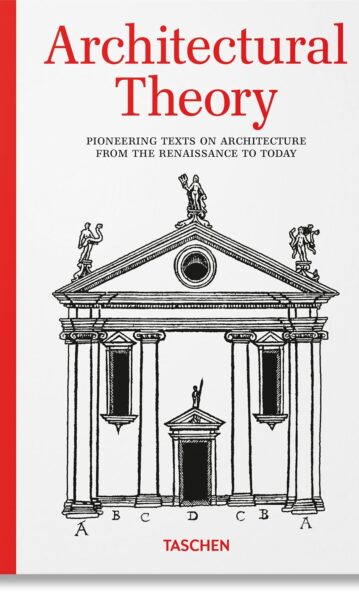
Architectural Theory
155,00 ₾If you’ve ever wondered what goes through architects’ minds when they design buildings, you’ll be happy to know that there’s no shortage of brilliant reading material to satisfy your curiosity. Wading through the archives at your local library may prove fruitful to your endeavor, but it won’t give you the instant gratification that Architectural Theory will.This book brings together all of the most important and influential essays about architecture written since the Renaissance, copiously illustrated and neatly organized chronologically by country. From Alberti and Palladio to Le Corbusier and Koolhaas, the best treatises by architecture’s greatest masters are gathered here, each accompanied by an essay discussing its historical context and significance. This is the all-in-one, must-have book for anyone interested in what architects have to say about their craft.The comprehensive overview that will help transform even the most uninformed novices into well-informed connoisseurs!



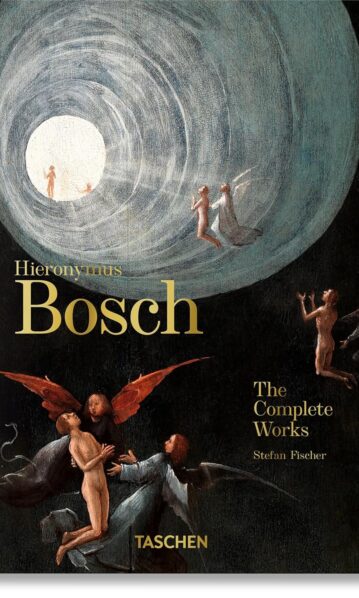
Hieronymus Bosch. The Complete Works
110,00 ₾Only 20 paintings and eight drawings are confidently assigned to Netherlandish painter Hieronymus Bosch (c. 1450–1516) but in their fantastical visions they have secured his place as one of the most cult artists in history. 500 years on from his death, his works continue to inspire scholars, artists, designers, and musicians, death metal band names and designer dresses.
This edition offers the complete and haunting Bosch world in one compact format. Through full spreads and carefully curated details, we explore the full reach and compelling inventions of the artist’s genius as well as disturbing imagination. We encounter his hybrid creatures, his nightmarish scenarios, his religious and moral framework, and his pictorial versions of contemporary proverbs and idioms. Along the way, art historian and Bosch expert Stefan Fischer reveals the most important themes and influences in these cryptic, mesmerizing masterpieces.
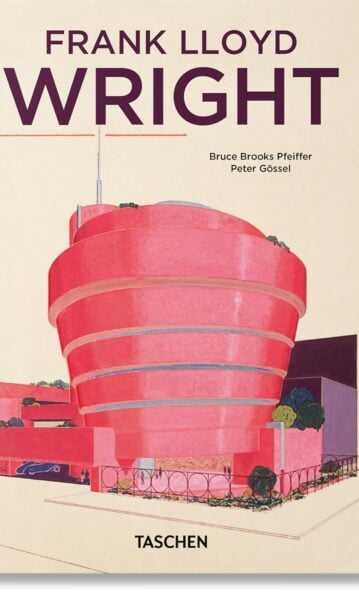
Frank Lloyd Wright
110,00 ₾A building by Frank Lloyd Wright (1867–1959) is at once unmistakably individual and evocative of an entire era. Notable for their exceptional harmony with their environment, as well as for their use of steel and glass to revolutionize the interface of indoor and outdoor, Wright’s designs helped announce the age of modernity, as much as they secured his place in the annals of architectural genius.
This meticulous compilation from TASCHEN’s previous monograph assembles the most important works from Wright’s extensive, paradigm-shifting oeuvre into one authoritative overview of America’s most famous architect. Based on unlimited access to the Frank Lloyd Wright Foundation’s archives at Taliesin West in Arizona, the collection spans the length and breadth of Wright’s projects, both realized and unrealized, from his early prairie houses, the Usonian concept homes, and the extraordinary Fallingwater to the Tokyo years, his designs for administrative buildings and places of worship, and later high-profile projects like the Guggenheim Museum in New York, as well as his fantastic visions for a better tomorrow with “The Living City.”
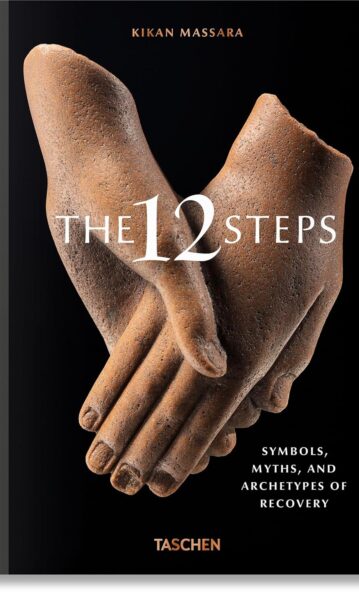
The 12 Steps. Symbols, Myths, and Archetypes of Recovery
160,00 ₾Drawing on art, literature, and scientific research, scholar and therapist Kikan Massara delves into the Twelve Steps – the widely used and respected program of recovery. Developed in the early 20th century to address alcoholism, the Twelve Step program was later found to be an effective tool in aiding recovery for all types of addictions and compulsive behaviors.
Now for the very first time, Twelve Step recovery is linked to a visual narrative. This inspiring edition features over 150 timeless and compelling works of art — from antiquity to the present day — to metaphorically describe a soulful path toward healing and transformation using these principles of recovery that continue to help millions.
Featuring in-depth studies by leading experts in several converging fields, the book examines the history behind the Twelve Steps, from the program’s origins in Depression-era America to building a foundation for recovery that incorporates concepts identified by psychologist C. G. Jung. The volume also offers relevant insight into the meaning of addiction in today’s society. With striking imagery, literary quotations, and psychological references, the Twelve Step program is reintroduced to a wider audience as timely, accessible, and constructive. At a time of radical change and opportunity, this visual edition honors the transformative power of these universal principles and thoughtfully explores ways of aligning with them.

20th Century Alcohol & Tobacco Ads
110,00 ₾Vices or virtues: drinking and smoking provided marketers with products to be forged into visual feasts. In this lush compendium of advertisements, we explore how depictions of these commodities spanned from the elegant to the offbeat, revealing how manufacturers prodded their customers throughout the 20th century to imbibe and inhale.Each era’s alcohol and tobacco trends are exuberantly captured page after page, with brand images woven into American popular culture so effectively that almost anyone could identify such icons as the Marlboro Man or Spuds MacKenzie, figures so familiar they could appear in ads without the product itself. Other advertisers devised clever and subliminal approaches to selling their wares, as the wildly successful Absolut campaign confirmed. Even doctors contributed to a perverse version of propaganda, testifying that smoking could calm your nerves and soothe your throat, while hailing liquor as an elixir capable of bringing social success.Whether you savor these visual delights, or enjoy inhaling and wallowing in forbidden pleasures, you will certainly be thrilled by this exploration of a decidedly vibrant—and sometimes controversial—chapter of advertising history.


Polaroid Book
110,00 ₾The Polaroid Corporation’s photography collection is the greatest portfolio of Polaroid images in the world. Begun by Polaroid founder Edwin Land and photographer Ansel Adams, the collection now includes some 23,000 images by hundreds of photographers throughout the world, including pieces by the likes of David Hockney, Andy Warhol, and Jeanloup Sieff.
The Polaroid Book dives into these archives, paying tribute to a medium that continues to defy the digital age. Like an oversized Polaroid film pack, this collection curates works by luminaries and unknowns alike, celebrating the boundless possibilities that develop inside the white borders of the original instant photograph.
Features: more than 250 works from the Polaroid Collections an essay by Polaroid’s Barbara Hitchcock on the beginnings of instant photography and the collection’s history a chapter featuring the various types of Polaroid cameras.

Rock Covers
110,00 ₾Dig into the 750 album covers that made rock history. Fact sheets, insider interviews, and lists from leading collectors take you on a musical memory tour. Covering everyone from Elvis to Bowie to The Sex Pistols, this complete volume includes bonus info on 250 records that became turning points for a band, an artist, or a genre.

Cabinet of Curiosities
110,00 ₾Cabinets of curiosities fascinated people of the 16th and 17th centuries. They offered a glimpse into a world full of natural wonders and treasures that aimed to reflect the order of the universe. This volume takes us through the world’s most beautiful collections, into the Medici treasury or the Green Vault (Grünes Gewölbe) of Dresden, and offers no less than a brief cultural history of the miraculous.

The Marvel Age of Comics 1961-1978
110,00 ₾The Marvel Age of Comics was a triumphant era of comic book and pop culture innovation that redefined the superhero genre. This treasure trove of images and exclusive insights reveals the making of such popular characters as the Hulk and Spider-Man, as well as the legends who created them, from Stan “The Man” Lee to Jack “King” Kirby.

Scandinavian Design
110,00 ₾What makes Scandinavia such a hotbed of design talent and innovation? Explore masterful forms and lyrical lines from across Norway, Sweden, Denmark, Iceland, and Finland in this stylish book. Bridging the gap between crafts and industrial production, organic forms and functionality, this must-have guide includes in-depth entries on 125 designers.

The Ultimate Sneaker Book
110,00 ₾Sneaker Freaker has been at the forefront of the global sneaker scene for over two decades. With over 500 redesigned pages, fresh photography, immense historical detail, and otaku-level minutiae, this anthology combines the magazine’s finest and content created exclusively for this book into one big celebration of sneakers.

The Package Design Book (2)
80,00 ₾Package design is one of the most dynamic and fast-evolving fields of design today. Featuring over 600 creations from more than 35 countries, this compact edition celebrates extraordinary work from the global packaging design community. Showcasing the winners of the Pentawards from the past decade, the world’s leading packaging design competition.

The Costume History
80,00 ₾The evolution of style from antiquity to 1888
Originally published in France between 1876 and 1888, Auguste Racinet’s Le Costume Historique was in its day the most wide-ranging and incisive study of clothing ever attempted. Covering the world history of costume, dress, and style from antiquity through to the end of the 19th century, the six volume work remains completely unique in its scope and detail.
This TASCHEN reprint presents Racinet’s exquisitely precise color illustrations, as well as his delightful descriptions and often witty commentary. Spanning everything from ancient Etruscan attire to French women’s couture, material is arranged according to Racinet’s original plan by culture and subject. As expansive in its reach as it is passionate in its research and attention to detail, Racinet’s Costume History is an invaluable reference for students, designers, artists, illustrators, and historians; and a rich source of inspiration for anyone with an interest in clothing and style.

Small Architecture
80,00 ₾Big ideas for small buildings
Over the years, talented architects have occasionally indulged themselves with the challenge of designing small but perfectly formed buildings. Today, with reduced budgets, many architects have turned in a more focused way to creating works that may be diminutive in their dimensions, but are definitely big when it comes to trendsetting ideas. Whether in Japanese cities, where large sites are hard to come by, or at the frontier between art and architecture, small buildings present many advantages, and push their designers to do more with less.
A dollhouse for Calvin Klein in New York, a playhouse for children in Trondheim, vacation cabins, and housing for victims of natural disasters are all part of the new rush to develop the great small architecture of the moment. The 2013 Pritzker Prize winner Toyo Ito is here, but so are emergent architects from Portugal, Chile, England, and New Zealand. From world-famous names to the freshest new talent, come discover architectural invention on a whole new, small scale.
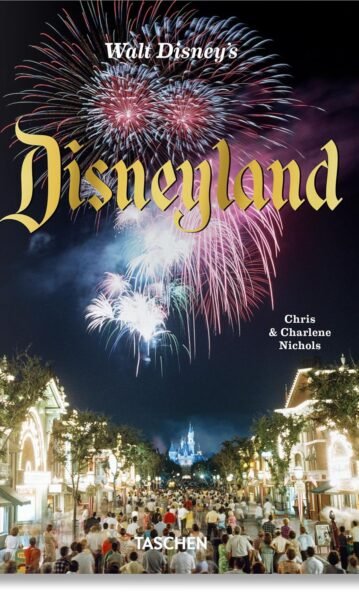
Walt Disney’s Disneyland
58,00 ₾A visual history of the world’s magic megalopolis
Walt Disney dreamed for decades about opening the ultimate entertainment venue, but it wasn’t until the early 1950s that his handpicked team began to bring his vision to life. Together, artists, architects, and engineers transformed a dusty tract of orange groves about an hour south of Los Angeles into one of the world’s most beloved destinations.
Today, there are Disney resorts from Paris to Shanghai, but the original Disneyland in Anaheim, California, which has been visited by more than 800 million people to-date, remains one of America’s most popular attractions. From the day it opened on July 17, 1955, Disneyland brought history and fairy tales to life, the future into the present, and exciting cultures and galaxies unknown to our imaginations.
This intruiging visual history draws on Disney’s vast historical collections, private archives, and the golden age of photojournalism to provide unique access to the concept, development, launch, and enjoyment of this sun-drenched oasis of fun and fantasy. Disneyland documents Walt’s earliest inspirations and ideas, the park’s extraordinary feats of design and engineering, and each of its immersive “lands” from Main Street, U.S.A., to Tomorrowland. It is a treasure trove of original Disney documentation and expertise, with award-winning writer Chris Nichols drawing on his extensive knowledge of both Disneyland and Southern California history to reveal the fascinating tale of “the happiest place on Earth.”

Bosch
58,00 ₾Hieronymus Bosch’s meticulous visions of the grotesque, debauched, and divine
As cryptic as they are compelling, the masterpieces of Hieronymus Bosch (c. 1450–1516) remain some of the most enduring enigmas of the art world. Their intricate, allegorical, and often startling content has captivated not only art historians, but also fashion designers, rock stars, writers, and punk rockers, as well as countless modern and contemporary artist successors.
Although rooted in the Old Netherlandish tradition, Bosch developed a highly subjective, richly suggestive style to render both the celestial bliss of heaven and the grotesque tortures of hell, most famously and meticulously excecuted in The Garden of Earthly Delights. Here, as in his other known works, his artistic language combined religious humility with a razor-sharp wit, often playing off pictorial versions of contemporary proverbs or figures of speech.
This book ties together the elusive threads of Bosch’s oeuvre to provide a concise introduction to an at once haunting and enthralling pictorial world.

Turner
58,00 ₾Turner’s iridescent tableaux
In the work of Joseph Mallord William Turner (1775–1851) lies an impact akin to a sudden acquisition of sight. His landscapes and seascapes scorch the eye with such ravishing light and color, with such elemental force, it is as if the sun itself were gleaming out of the frame.
Appropriately known as “the painter of light,” Turner worked in print, watercolor, and oils to transform landscape from serene contemplative scenes to pictures pulsating with life. He anchored his work to the River Thames and to the sea, but in the historical context of the Industrial Revolution, also integrated boats, trains, and other markers of human activity, which juxtaposes the thrust of civilization against the forces of nature.
This book covers Turner’s illustrious, wide-ranging repertoire to introduce an artist who combined a traditional genre with a radical modernism.

Le Corbusier
58,00 ₾The man with a modern mission
Born Charles-Édouard Jeanneret, Le Corbusier (1887–1965) is widely acclaimed as the most influential architect of the 20th century. From private villas to mass social housing projects, his radical ideas, designs, and writings presented a whole-scale reinvention not only of individual structures, but of entire concepts of modern living.
Le Corbusier’s work made distinct developments over the years, from early vernacular houses in Switzerland through dazzling white, purist villas to dynamic syntheses of art and architecture such as the chapel at Ronchamp and the civic buildings in Chandigarh, India. A hallmark throughout was his ability to combine functionalist aspirations with a strong sense of expressionism, as well as a broader and empathetic understanding of urban planning. He was a founding member of the Congrès international d’architecture moderne (CIAM), which championed “architecture as a social art.”
This book presents some of Le Corbusier’s landmark projects to introduce an architect, thinker, and modern pioneer who, even in his unrealized projects, offered discussion and inspiration for generations to come.

Rubens
58,00 ₾Meet Sir Peter Paul Rubens, master painter and polymath
There are over 1,000 catalogued works by Sir Peter Paul Rubens (1577–1640), the 16th-century flag bearer for Baroque drama, movement, and sensuality. This essential introduction takes in the most important works from this astonishingly prolific oeuvre to explore Rubens’s influences and innovations, and his remarkable visual, and art historical, impact.
The richly illustrated survey takes in Rubens’s portraits, landscapes, and historical paintings, as well as his famed and bountiful nudes. Along the way, we examine the artist’s astonishing technique and his deft ability to depict narrative in a compelling and legible visual form, whether an erotic mythological scene or a tender biblical story. This remarkable artistic bravura is placed in context both within Rubens’s long art historical legacy through Van Dyck, Velázquez, and beyond, and his other talents as a classical scholar, diplomat, and knight.

Schiele
58,00 ₾Radical and all-revealing figures
With his graphic style, figural distortion, and defiance of conventional standards of beauty, Egon Schiele (1890–1918) was a pioneer of Austrian Expressionism and one of the most startling portrait painters of the 20th century.
Mentored by Gustav Klimt, Schiele dabbled in a glittering Art Nouveau style before developing his own much more gritty and confrontational aesthetic of sharp lines, lurid shades, and mannered, elongated figures. His prolific portraits and self-portraits stunned the Viennese establishment with an unprecedented psychological and sexual intensity, favoring erotic, exposing, or unsettling poses in which he or his sitters cower on the floor, languish with legs akimbo, glower at the viewer, and thrust their genitalia into the foreground. His models are at times skeletal and sickly, at other times strong and sensual.
Many contemporaries found Schiele’s work to be not only ugly but morally objectionable; in 1912, the artist was briefly imprisoned for obscenity. Today, his oeuvre is celebrated for its revolutionary approach to the human figure and for its direct and particularly fervent, almost furious brand of draftsmanship. This book presents key Schiele works to introduce his short but urgent career and his profound contribution to the development of modern art, which reaches right through to such contemporary talents as Tracey Emin and Jenny Saville.

Hundertwasser
58,00 ₾Friedensreich Hundertwasser, hero of fluid forms and ecology
Vivid color, organic forms, and a loathing of straight lines were just a few stalwart characteristics in the unique practice of Friedensreich Hundertwasser (1928–2000). A non-conformist hero, the artist, architect, and activist left a blazing trail of imagination and ideas in buildings, paintings, manifestos, initiatives, and more.
Hundertwasser’s best-known work is considered by many to be the Hundertwasserhaus in Vienna, a structural synthesis of the vitality and uniqueness that determined the artist’s entire oeuvre. For Hundertwasser, rational, sterile, monotonous buildings caused human misery. He called for a boycott of the modernist paradigm championed by the likes of Adolf Loos, and campaigned instead for an architecture of creative freedom and ecological commitment. A fierce opponent of straight lines, which he called “godless and immoral,” Hundertwasser was fascinated by the spiral, drawing also on the Secessionist forms of Klimt and Schiele.
This richly illustrated book traces Hundertwasser’s style and vision not only for each building, but for society at large. From naked addresses at the end of the 1960s to worldwide architecture projects and alternative blueprints for society, author Pierre Restany explores Hundertwasser’s most high-profile and innovative ideas in a thrilling introduction to a pioneering 20th-century mind.

Futurism
58,00 ₾The action men of modernism
With motion and machines as its most treasured tropes, Futurism was founded in 1909 by Filippo Tommaso Marinetti, along with painters Giacomo Balla, Umberto Boccioni, Carlo Carrà, and Gino Severini. With affiliate painters, sculptors, designers, architects, and writers, the group sought to subsume the dusty establishment into a new age of sleek, strong, purified modernity.
Futurism’s place in art history is as ambivalent as it is important. The movement pioneered revolutionary methods to convey movement, light, and speed, but sparks controversy in its glorification of war and fascist politics. Their frenzied, almost furious, canvases, are as remarkable for their macho aggression as they are for their radical experimentation with brushstrokes, texture, and color in the quest to record an object moving through space.
With key examples from the Futurists’ prolific output and leading practitioners, this book introduces the movement that spat vitriol at all -isms of the past and, in so doing, created an -ism of their own.

Dürer
58,00 ₾The art, theory, and woodcut print revolution of Albrecht Dürer
A polymath of the German Renaissance, Albrecht Dürer (1471–1528) was a prolific artist, theorist, and writer whose works explored everything from religion to art theory to philosophy. His vast body of work includes altarpieces, portraits, self-portraits, watercolors, and books, but is most celebrated for its astonishing collection of woodcut prints, which transformed printmaking from an artisan practice into a whole new art form.
Dürer’s woodcuts astonish in scale as much as detail. Through works such as Apocalypse and the Triumphal Arch for Emperor Maximilian I, he created dense, meticulous compositions that were much larger, much more finely cut, and far more complex than any earlier woodcut efforts. With an ambitious tonal and dynamic range, he introduced a new level of conceptual, emotional, and spiritual intensity. His two major woodcut series on Christ’s Passion, named The Large Passion and The Small Passion after their size, are particularly remarkable for their vivid human treatment of the Christian narrative. In his copper engraving, Melancholia I, meanwhile, Dürer created a startling vision of emotional ennui, often cited as a defining early image of a depressive or melancholic state.
Ever inquisitive, Dürer absorbed ideas not only from masters and fellow artists in Germany but also from Italy, while his own influence extended across Europe for generations to come. In this essential TASCHEN introduction, we explore this pioneering figure’s complex practice, his omnivorous intellect, and the key works which shaped his enduring legacy.

Caravaggio
58,00 ₾The Baroque genius who electrified art history
Michelangelo Merisi da Caravaggio (1571–1610) was always a name to be reckoned with. Notorious bad boy of the Italian Baroque, the artist was at once celebrated and controversial, violent in temper, precise in technique, a creative master, and a man on the run.
Though famed for his dramatic use of color, light, and shadow, it was above all Caravaggio’s boundary-breaking naturalism which scorched his name into the annals of art history. From the dirtied soles of feet to the sexualized languor of bare flesh, the artist allowed even sacred and biblical scenes to unfold with a startling, often visceral humanity. This vivid pictorial world was accompanied by an equally intense personal biography, scored by gambling, debts, drunken brawls, and even a murder charge.
This book brings together more than 50 of Caravaggio’s most famous and revolutionary works to explore how and why this artist is now considered the most important painter of the early Baroque period and one of the defining influences of art history, without whom Ribera, Vermeer, Rembrandt, Delacroix, Courbet, and Manet could never have painted the way they did.